




RFID Readers in Australia: How to Choose the Right UHF Tag Reader for Your Business
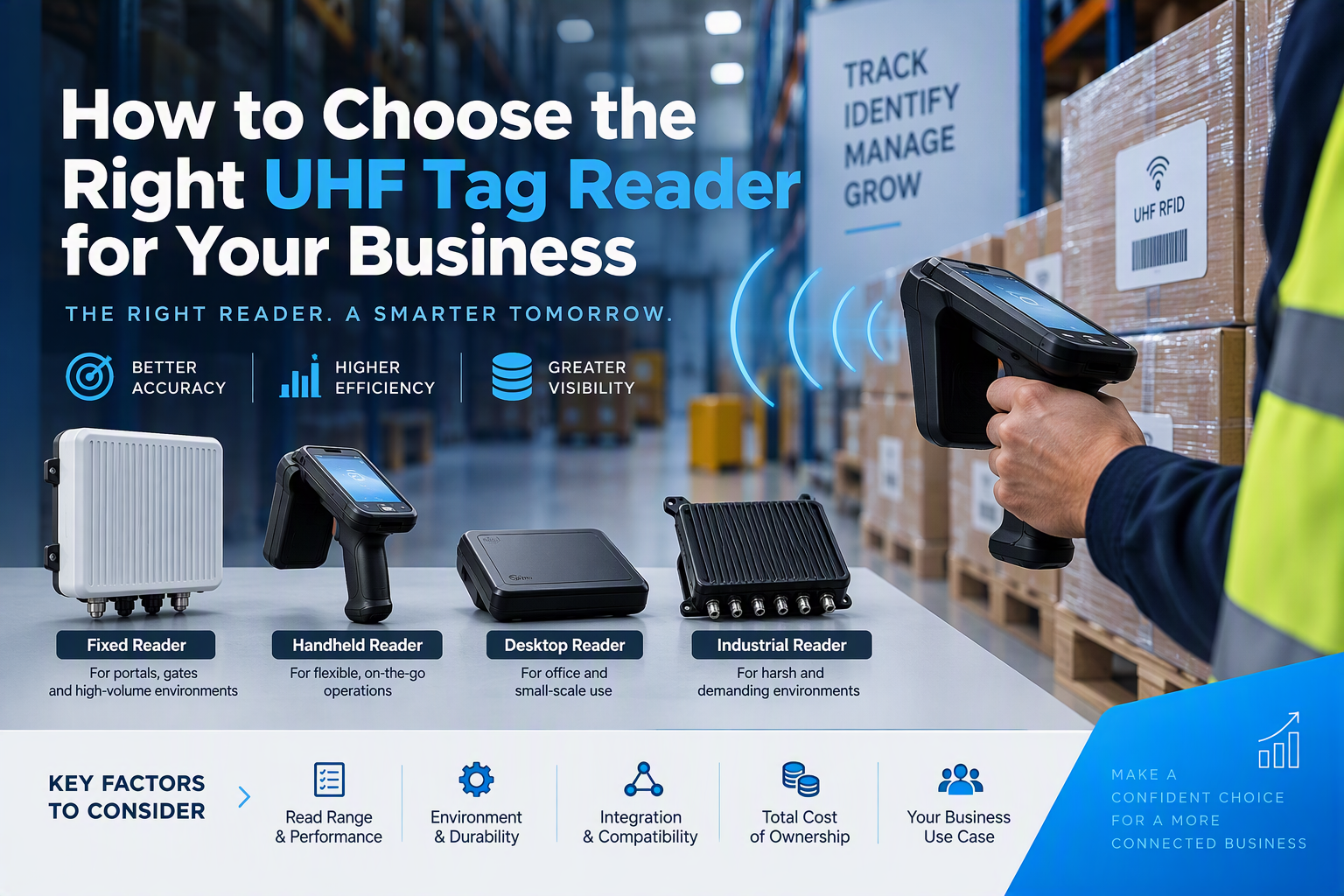
Tracking stock, equipment or assets manually can become difficult as a business grows. Barcodes remain useful, but they generally require a clear line of sight and individual scanning. RFID technology offers a different approach by allowing compatible tags to be identified using radio waves.
For Australian warehouses, retailers, manufacturers, logistics operators and asset-intensive businesses, choosing the right RFID readers is an important part of building a reliable RFID system.
The reader is responsible for communicating with RFID tags and passing the collected information to software or another business system. Choosing one purely on advertised reading distance can lead to disappointing results. Frequency, antenna configuration, environment, tag placement and software compatibility can all influence real-world performance.
This guide explains what to consider before selecting RFID hardware and where a UHF Tag Reader can provide practical advantages.
What Do RFID Readers Actually Do?
An RFID reader sends and receives radio signals to communicate with compatible RFID tags.
Each tag typically contains electronically stored identification information. When a tag enters the reader's effective reading area, that information can be captured and transferred to software for processing.
Depending on the system, businesses may use this data to identify:
Inventory moving through a warehouse
Tools assigned to employees
Equipment entering or leaving a facility
Products passing through a distribution point
Pallets, cartons or containers in logistics operations
Assets stored across multiple locations
Unlike traditional barcode scanning, RFID systems can often identify multiple tagged items without requiring each label to be individually positioned in front of a scanner.
That capability can make RFID particularly useful where businesses regularly handle large numbers of products or assets.
Why UHF RFID Is Commonly Used for Asset and Inventory Tracking
RFID technologies operate across different frequency ranges, and they are suited to different applications.
Ultra-high frequency RFID is frequently selected for supply chains, warehousing, manufacturing and asset management because it can support longer reading ranges and rapid identification of multiple compatible tags.
A UHF Tag Reader communicates with UHF RFID tags placed on items such as cartons, pallets, equipment or products.
Australia has specific radiofrequency arrangements that businesses and equipment suppliers need to consider. ACMA documentation includes RFID operation within the 918–926 MHz range and provisions for higher-powered RFID transmitters within 920–926 MHz, subject to applicable technical requirements.
For this reason, businesses should confirm that readers supplied for Australian deployments are configured appropriately for local regulatory requirements rather than assuming equipment intended for another market can simply be installed unchanged.
Fixed RFID Readers vs Handheld Readers
One of the first decisions is whether your operation requires fixed infrastructure, portable equipment or a combination of both.
Fixed RFID Readers
Fixed readers are normally installed at permanent reading points.
Common locations include warehouse entrances, loading bays, production lines, doorways and conveyor systems.
For example, a distribution centre could position antennas around a dispatch doorway. Tagged cartons passing through that area could then be identified automatically instead of requiring an employee to scan every carton individually.
Fixed readers are particularly useful where items repeatedly move through predictable locations.
Handheld RFID Readers
Handheld readers give employees greater flexibility.
A worker might carry one through warehouse aisles to locate products, conduct stock checks or identify equipment. Because the employee can move the reader around the environment, handheld systems can be useful where assets are spread across a large area.
Some operations use both approaches: fixed readers monitor key movement points while handheld devices support stocktaking, searching and exception handling.
Reading Distance Should Not Be Your Only Buying Criterion
Reader manufacturers often discuss reading range, but the maximum figure shown on a specification sheet does not necessarily represent what you will achieve inside your facility.
RFID performance is affected by several factors.
Tag Type
Different RFID tags have different antenna designs and performance characteristics.
A small label designed for retail packaging may behave differently from an industrial tag designed for equipment.
Material Being Tagged
Metal and liquids can affect UHF RFID performance significantly.
A standard tag attached directly to a metal asset, for example, may not perform as expected. Specialised on-metal RFID tags are available for these situations.
Products containing liquids can also require careful tag positioning and testing.
Reader and Antenna Position
Where antennas are installed can be just as important as the reader itself.
An antenna placed at the wrong height or angle may create inconsistent coverage or detect tags that were never meant to be captured.
Power Settings
More transmit power is not automatically better.
Excessive power can sometimes result in tags being detected outside the intended reading zone. A well-designed system aims for reliable detection within the required area rather than simply maximising distance.
Consider the Physical Environment Before Choosing RFID Readers
An RFID deployment that works perfectly in a demonstration room may behave differently inside a working warehouse.
Before selecting equipment, examine the actual environment where it will operate.
Warehouses may contain steel shelving, machinery, forklifts, stacked pallets and products with varying material compositions. Manufacturing facilities can introduce vibration, dust, heat or moisture. Outdoor environments introduce another set of requirements.
For industrial applications, check the equipment's environmental specifications and enclosure rating rather than assuming every reader is suitable for demanding conditions.
A site survey or small pilot deployment can reveal potential issues before equipment is rolled out across an entire operation.
Antennas Matter More Than Many Buyers Expect
Businesses sometimes focus heavily on the reader while treating antennas as accessories. In practice, antenna selection has a major influence on system performance.
A fixed UHF reader may support several external antennas. Their number, type and positioning determine where RFID tags can be detected.
For a warehouse doorway, antennas might be positioned to create a controlled reading zone. On a conveyor, the goal may be to identify tags only as products pass through a particular section.
The right configuration depends on what you are trying to detect and where you need detection to happen.
This is why RFID planning should begin with the workflow rather than the hardware catalogue.
Check Software and Integration Requirements
Capturing an RFID tag number is only one part of the process.
That information normally needs to reach another system, such as:
Warehouse management software
Inventory platforms
Enterprise resource planning systems
Asset management software
Manufacturing applications
Custom cloud platforms
Before choosing RFID readers, confirm which communication interfaces, APIs, SDKs or network connections the equipment supports.
Your software also needs rules for interpreting RFID events.
For instance, reading the same tag ten times in two seconds should not necessarily create ten separate inventory movements. Middleware or application logic may need to filter duplicate reads and determine what each detection actually means.
Businesses planning an RFID project should therefore involve both operational and IT teams early in the process.
Think About Tag Density
Reading one RFID tag on a desk is relatively straightforward. Reading hundreds of tags packed closely together can be more demanding.
High-density environments are common in warehouses, retail stockrooms and distribution centres.
If your application involves large quantities of tags, test the system using realistic volumes rather than evaluating it with only a few sample tags.
Place products in the same cartons, shelving and pallet arrangements that will be used in daily operations.
Realistic testing provides much more useful information than laboratory-style demonstrations.
Questions to Ask Before Buying a UHF Tag Reader
Before purchasing a reader, clearly define the operational problem you want RFID to solve.
Useful questions include:
What exactly are we tracking?
Products, pallets, vehicles, tools and fixed assets can require different tags and reading arrangements.Where should tags be detected?
Determine whether reading will happen at doors, desks, production stations, shelves or throughout an open area.How many tags could appear at once?
Reader performance requirements can vary considerably between single-item identification and bulk inventory reading.What materials surround the tags?
Metal, liquids and dense product packaging should be considered during testing.Which business system needs the data?
Integration requirements should be established before hardware is selected.Will the equipment operate indoors or outdoors?
Environmental protection may affect the type of reader and antenna you need.Does the hardware suit Australian radio requirements?
Equipment should be selected and configured for compliant operation in Australia. ACMA manages Australia's radiofrequency spectrum and publishes the relevant spectrum and low-interference-device arrangements.
Answering these questions helps narrow down the options considerably.
Pilot the System Before a Large Rollout
RFID performance depends heavily on the environment, so a pilot project is one of the most practical steps a business can take.
Rather than immediately deploying hundreds of tags and multiple readers, test a smaller section of the workflow first.
For example, a warehouse could trial RFID at one dispatch doorway using the actual products, tags, pallets and equipment expected in normal operation.
During the pilot, measure whether tags are being detected consistently and whether unwanted tags are also being captured.
You can then adjust antenna positions, power settings, tag placement or software rules before expanding the system.
This approach can uncover problems that would be difficult to predict from product specifications alone.
Building a More Reliable RFID System
The best RFID reader is not necessarily the one offering the longest advertised range or the highest number of features.
A reliable system comes from matching the hardware to the environment and workflow.
Start by identifying what needs to be tracked, where tags need to be detected and how the resulting information will be used. Then consider reader type, antenna placement, tag design, surrounding materials, software integration and Australian operating requirements.
For applications involving warehouses, inventory, logistics or industrial assets, a properly configured UHF Tag Reader can make identification far more efficient than processes based entirely on individual manual scans.
Selecting suitable RFID readers is therefore less about buying a single piece of hardware and more about designing a complete identification system that performs consistently under real working conditions.
Frequently Asked Questions
What is an RFID reader?
An RFID reader is a device that communicates with compatible RFID tags using radiofrequency signals. It captures information stored on the tags and sends that data to software or another connected system.
What is a UHF Tag Reader used for?
A UHF Tag Reader is commonly used for applications such as warehouse inventory, logistics, pallet tracking, equipment identification and asset management where multiple tags or greater reading distances may be required.
Can RFID readers scan multiple tags at the same time?
Many UHF RFID systems are designed to identify multiple tags within a reading area. Actual performance depends on the reader, tags, antenna configuration, tag density and surrounding environment.
Can RFID tags be read through boxes?
RFID signals can often communicate with tags inside or attached to cartons, but performance depends on the packaging material and contents. Products containing metal or liquids may require specialised tags or different placement.
How should an Australian business choose an RFID reader?
Start with the application rather than the product specifications. Consider what will be tracked, reading locations, tag quantity, environmental conditions, software integration and compatibility with Australian radiofrequency requirements before selecting equipment.
At TrackSeal, we help businesses design and implement RFID solutions tailored to their operational needs. From asset tracking and inventory management to warehouse automation and supply chain visibility, our experts can help you unlock the full potential of RFID technology.
Ready to explore RFID for your business?
Contact TrackSeal today for a free consultation and discover how RFID can transform your operations