




What Is RFID Technology and How Does It Work?
Introduction
In today's fast-paced business environment, organizations
need accurate, real-time visibility into their assets, inventory, and
operations. Traditional tracking methods such as manual record-keeping and
barcode scanning often create bottlenecks, increase labor costs, and leave room
for human error.
This is where Radio Frequency Identification (RFID)
technology comes in.
RFID enables businesses to automatically identify, track,
and manage assets without requiring direct line-of-sight scanning. From
warehouses and retail stores to hospitals and manufacturing facilities, RFID is
helping organizations improve efficiency, reduce losses, and gain valuable
operational insights.
What Is RFID?
Radio Frequency Identification (RFID) is a wireless
technology that uses radio waves to identify and track objects equipped with
RFID tags.
An RFID system can automatically collect data from tagged
items and transmit that information to business applications, providing
real-time visibility across operations.
Unlike traditional barcodes, RFID tags can often be read
without direct visibility and multiple tags can be scanned simultaneously.
Key Components of an RFID System
1. RFID Tags
An RFID tag contains:
- A
microchip that stores information
- An
antenna that transmits data
RFID tags can be attached to:
- Products
- Pallets
- Equipment
- Tools
- Vehicles
- Documents
2. RFID Readers
RFID readers emit radio signals that communicate with RFID
tags.
Readers can be:
- Fixed
readers installed at entry or exit points
- Handheld
readers used for inventory audits
- Mobile
readers integrated into vehicles or equipment
3. Antennas
Antennas transmit and receive radio frequency signals
between readers and tags.
Strategic antenna placement is critical for achieving
optimal read accuracy.
4. RFID Software
The software layer collects, analyzes, and integrates RFID
data into business systems such as:
- ERP
platforms
- Warehouse
Management Systems (WMS)
- Asset
Management Systems
- Inventory
Management Software
How RFID Works
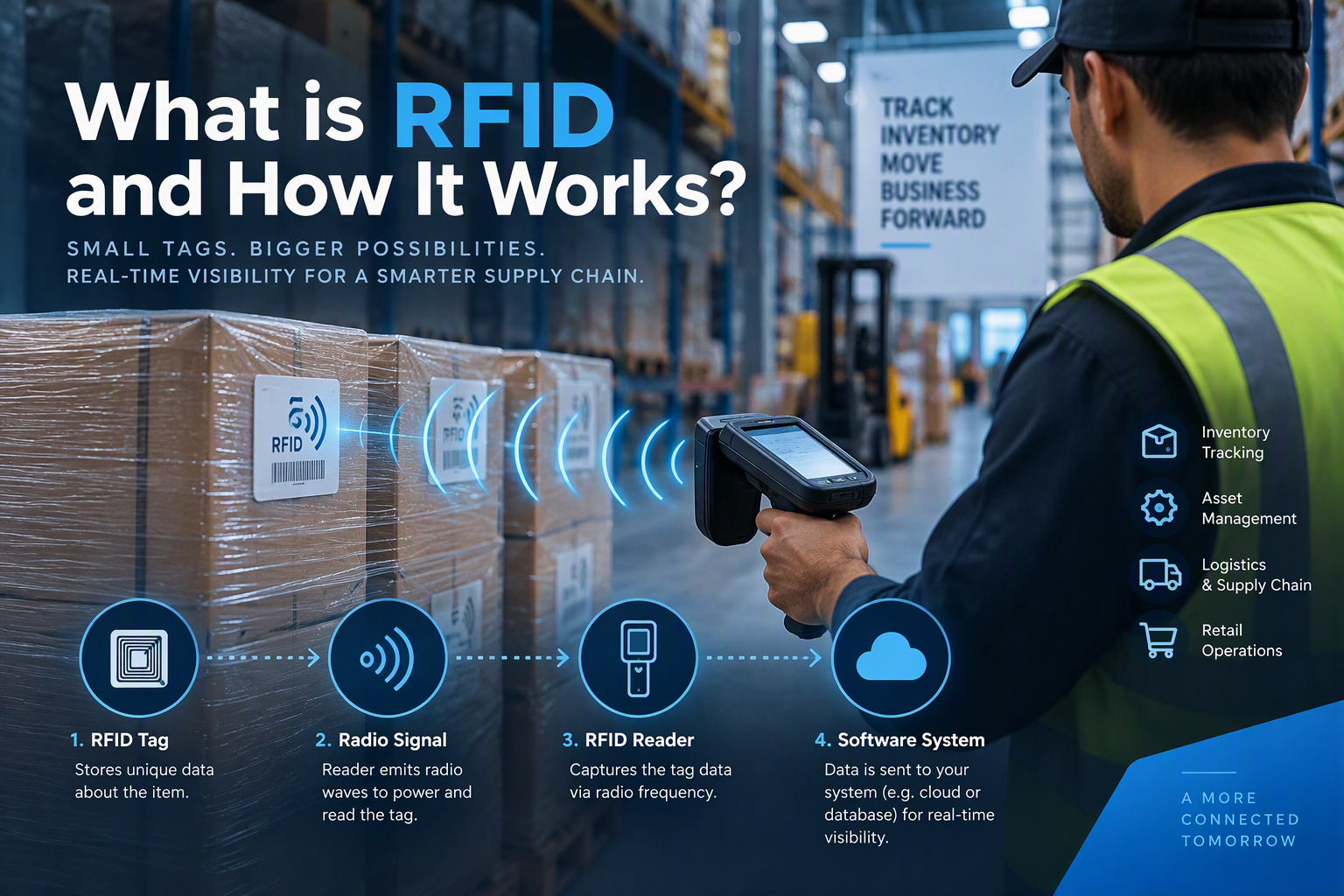
The RFID process is surprisingly simple.
Step 1: Tagging
An RFID tag is attached to an item, asset, or product.
Step 2: Signal Transmission
The RFID reader emits a radio frequency signal.
Step 3: Tag Response
When the tag enters the reader's range, it responds by
transmitting its stored information.
Step 4: Data Capture
The reader captures the information and sends it to the RFID
software platform.
Step 5: Actionable Insights
The software updates inventory records, tracks asset
locations, and generates reports in real time.
This entire process happens in seconds without manual
intervention.
Types of RFID Tags
Passive RFID Tags
Passive tags do not have their own power source.
Benefits:
- Lower
cost
- Smaller
size
- Longer
lifespan
- Ideal
for inventory and asset tracking
Common Applications:
- Retail
inventory
- Warehouse
management
- Supply
chain tracking
Active RFID Tags
Active tags contain an internal battery.
Benefits:
- Longer
read range
- Continuous
broadcasting
- Real-time
location tracking
Common Applications:
- Fleet
management
- Vehicle
tracking
- Large
industrial facilities
Semi-Passive RFID Tags
Semi-passive tags use batteries to power internal
electronics while relying on reader signals for communication.
Common Applications:
- Environmental
monitoring
- High-value
asset tracking
RFID vs Barcode Technology
|
Feature |
RFID |
Barcode |
|
Line of Sight Required |
No |
Yes |
|
Multiple Items Read Simultaneously |
Yes |
No |
|
Read Speed |
Fast |
Moderate |
|
Data Storage |
High |
Limited |
|
Durability |
High |
Medium |
|
Automation Potential |
Excellent |
Limited |
While barcodes remain useful for many applications, RFID
offers significantly greater automation and visibility for organizations
managing large volumes of assets and inventory.
Benefits of RFID Technology
Improved Inventory Accuracy
Many businesses struggle with inventory discrepancies caused
by manual processes.
RFID enables automated inventory tracking, significantly
improving accuracy and reducing stock variances.
Faster Stock Counts
Instead of manually scanning every item, RFID readers can
capture hundreds of tags within seconds.
This dramatically reduces inventory counting time.
Real-Time Visibility
Organizations gain instant visibility into:
- Asset
locations
- Inventory
levels
- Product
movement
- Operational
performance
Reduced Asset Loss
RFID helps prevent:
- Misplaced
assets
- Unauthorized
removals
- Inventory
shrinkage
- Equipment
loss
Labor Cost Savings
Automation reduces the time employees spend on:
- Stock
counts
- Asset
searches
- Data
entry
- Manual
audits
Enhanced Customer Satisfaction
Accurate inventory data ensures products are available when
customers need them, improving service levels and order fulfillment.
Industries Using RFID Today
Retail
Retailers use RFID to:
- Improve
inventory accuracy
- Prevent
stock-outs
- Support
omnichannel fulfillment
- Reduce
shrinkage
Warehousing and Logistics
RFID helps warehouses:
- Track
inventory movement
- Automate
receiving and shipping
- Improve
order accuracy
- Increase
operational efficiency
Manufacturing
Manufacturers use RFID for:
- Work-in-progress
tracking
- Tool
management
- Quality
control
- Production
visibility
Healthcare
Hospitals use RFID to track:
- Medical
equipment
- Pharmaceuticals
- Patient
assets
- Critical
supplies
Education and Libraries
RFID simplifies:
- Book
tracking
- Asset
management
- Equipment
lending
- Security
monitoring
Common RFID Applications
Some of the most popular RFID use cases include:
- Inventory
Management
- Asset
Tracking
- Warehouse
Automation
- Tool
Tracking
- Vehicle
Identification
- Access
Control
- Supply
Chain Visibility
- Retail
Stock Management
- Healthcare
Asset Tracking
Is RFID Right for Your Business?
RFID is particularly valuable if your organization:
✅ Manages large inventories
✅ Tracks high-value assets
✅ Struggles with inventory
accuracy
✅ Conducts frequent stocktakes
✅ Requires real-time visibility
✅ Wants to automate manual
processes
An RFID solution can generate measurable returns through
improved efficiency, reduced losses, and better operational decision-making.
Conclusion
RFID technology has evolved from a niche tracking tool into
a critical business solution for organizations seeking greater visibility,
automation, and control.
Whether you're managing a warehouse, tracking enterprise
assets, running a retail operation, or optimizing your supply chain, RFID
provides the real-time intelligence needed to drive efficiency and growth.
At TrackSeal, we help businesses design and implement
RFID solutions tailored to their operational needs. From asset tracking and
inventory management to warehouse automation and supply chain visibility, our
experts can help you unlock the full potential of RFID technology.
Ready to explore RFID for your business?
Contact TrackSeal today for a free consultation and discover how RFID can transform your operations